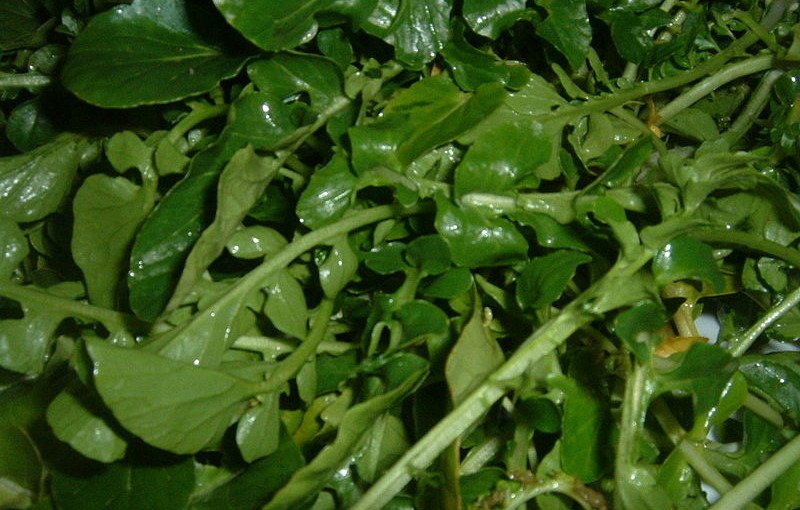
Watercress is an aquatic plant that grows rapidly in aquatic or semi-aquatic areas. It is native to Europe and Asia and is one of the oldest known leaf vegetables that are eaten by humans. Botanically, it is related to mustard, radish, garden cress, and wasabi.
It is cultivated on both a large scale and a garden scale and is well-suited to hydroponic cultivation and thrives best in water that is slightly alkaline.
It is is often sold in supermarkets in sealed bags that contain a little moisture and lightly pressurized so as to prevent crushing. It is also sold as sprouts where the edible shoots are harvested days after germination.
So can hamsters eat watercress?
Let’s take a look at their nutritional data and find out more. In particular, their acidic, water, sugar, fat, salt, phosphorus, and calcium content is of importance as far as hamsters are concerned.
We can then see if it is appropriate for all hamsters to eat.
Nutritional value per 100 g (3.5 oz)
Energy 46 kJ (11 kcal)
Carbohydrates
1.29 g
Sugars 0.2 g
Dietary fiber 0.5 g
Fat
0.1 g
Protein
2.3 g
Vitamins
Vitamin A equiv.
beta-carotene
lutein zeaxanthin
(20%) 160 μg
(18%) 1914 μg
5767 μg
Thiamine (B1) (8%) 0.09 mg
Riboflavin (B2) (10%) 0.12 mg
Pantothenic acid (B5)
(6%) 0.31 mg
Vitamin B6 (10%) 0.129 mg
Folate (B9) (2%) 9 μg
Vitamin C (52%) 43 mg
Vitamin E (7%) 1 mg
Vitamin K (238%) 250 μg
Minerals
Calcium (12%) 120 mg
Iron (2%) 0.2 mg
Magnesium (6%) 21 mg
Manganese (12%) 0.244 mg
Phosphorus (9%) 60 mg
Potassium (7%) 330 mg
Sodium (3%) 41 mg Water 93%
source wikipedia
As you can see watercress, contains an awful lot of water, a lot of phosphorus, calcium, acidic content, a hint of sugar and fat.
This means that all species of hamsters can eat watercress, but only in very small amounts due its acidic and water content.
A pinch of watercress should be fine for Syrian’s.
For dwarf hamsters, a couple of small stalks should suffice for them.
Make sure it is washed thoroughly before feeding it to them.